

Recruiting in the fast-changing European iGaming sector demands more than instinct. Every day, HR leaders are expected to find not only talented developers but also compliance officers and fraud specialists—roles with unique market pressures and fierce competition. By harnessing comprehensive workforce data about skills, compensation trends, and talent availability, your hiring decisions shift from guesswork to insight, helping you compete with companies well beyond iGaming and raise your employer visibility.
Table of Contents
Key Takeaways
| Point | Details |
| Importance of Workforce Data | Leveraging workforce data enhances hiring precision and helps identify talent availability and retention patterns in the iGaming industry. |
| Internal vs. External Data Sources | Combining internal hiring metrics with external market benchmarks provides a comprehensive view of competitive positioning in recruitment. |
| Analytics for Informed Decision-Making | Utilizing workforce analytics transforms raw hiring data into actionable insights, driving targeted recruitment and improved retention strategies. |
| Avoiding Common Pitfalls | Awareness of pitfalls such as mistaking correlation for causation and relying on outdated benchmarks is crucial for effective data-driven hiring decisions. |
Defining Workforce Data for iGaming Recruitment
Workforce data in iGaming isn’t just spreadsheets and headcount reports. It’s the strategic collection of information about your talent—skills, demographics, retention patterns, compensation, and market availability—that transforms hiring from guesswork into precision.
The iGaming industry has unique staffing needs. You’re not just hiring developers and designers; you’re recruiting specialized roles like compliance officers, risk managers, and fraud prevention specialists. Comprehensive data on employee skills and compensation trends directly supports your ability to attract and keep these hard-to-find professionals.
Why Workforce Data Matters in iGaming
Your competition isn’t just other iGaming operators in Europe. It’s financial services companies, tech firms, and startups all competing for the same talent pool. Workforce data reveals where these gaps exist and how to fill them.
Consider what workforce data actually captures:
-
Skills availability in your local market and across Europe
-
Salary benchmarks for specialized roles you’re hiring for
-
Retention patterns showing which roles have high turnover
-
Demographic shifts affecting your talent pipeline
-
Competitor hiring activity and talent movement
Understanding labor market dynamics and skills gaps enables you to implement strategic workforce practices that keep your hiring competitive and your teams stable.
Without this data, you’re making decisions on assumptions. With it, you’re making decisions based on what’s actually happening in the market right now.
How iGaming Workforce Data Differs
Other industries have mature talent markets. iGaming in Europe is still evolving. Your workforce data tells you something critical: are there enough compliance specialists in Malta? Are developers willing to relocate to Cyprus? What’s the actual salary expectation for a gaming mathematician?
These questions change everything about your hiring strategy. Understanding barriers like skills shortages and recruitment challenges globally helps you anticipate problems before they happen.
Workforce data in iGaming helps you balance three competing pressures:
-
Innovation - hiring talent ahead of your technology curve
-
Compliance - finding people who understand regulatory requirements
-
Scalability - building teams that grow with your business
This balance is uniquely difficult in iGaming because regulatory requirements vary by jurisdiction, innovation moves quickly, and skilled talent is scarce.
The Real Value for Your Team
When you have solid workforce data, your hiring moves from reactive to predictive. You stop posting job descriptions and hoping and start targeting markets where candidates actually exist.
You also gain transparency about your hiring challenges—which ones are market-wide and which ones are specific to your employer brand. That distinction matters tremendously when planning your strategy.
Pro tip: Start by analyzing your own hiring data from the past 12 months—time-to-hire, cost-per-hire, and where applications actually came from—before investing in external market data.
Major Types and Key Sources of Workforce Data
Workforce data comes in many forms, and knowing which types matter for your iGaming hiring strategy is crucial. You’ll encounter salary benchmarks, diversity metrics, turnover rates, skill inventories, and recruitment barriers—but not all of them matter equally for your specific hiring challenges.
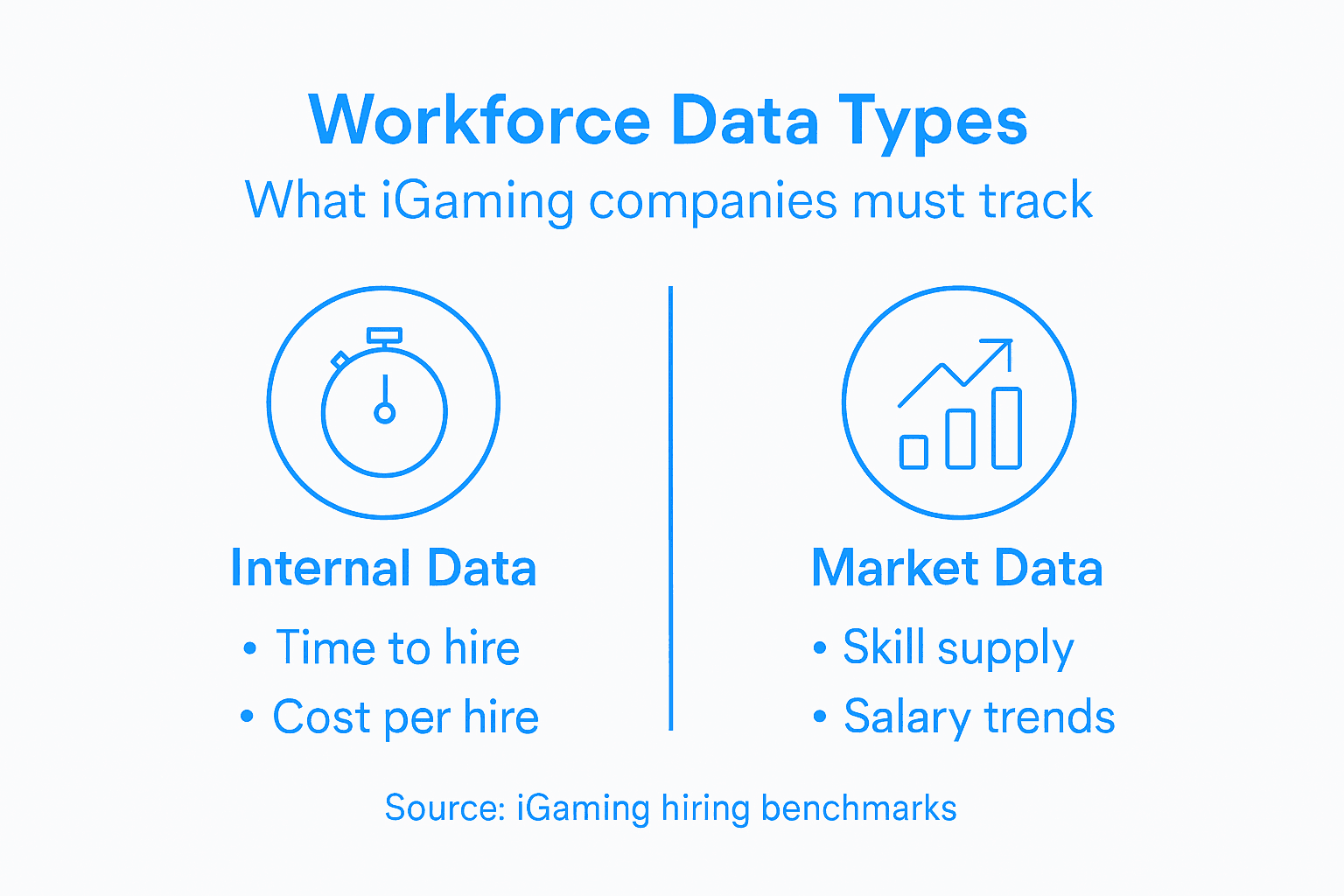
The key types break down into two categories: what you measure internally and what you measure against the market.
Data Types You Need to Track
Internal data comes from your own systems. This is the foundation. It tells you what’s actually happening inside your organization right now.

Market data comes from external sources. This tells you whether your internal patterns match industry norms or if you’re an outlier.
The major types you’ll encounter include:
-
Salary benchmarks showing what competitors pay for similar roles
-
Diversity metrics tracking representation across your teams
-
Turnover rates revealing which roles lose people fastest
-
Skill inventories mapping what capabilities exist in your workforce
-
Talent pipeline analyses predicting future availability
-
Retention statistics showing how long people actually stay
-
Recruitment barriers identifying obstacles to finding talent
Salary benchmarks, diversity metrics, and turnover data directly inform competitive positioning and workforce strategy decisions in iGaming.
Each type answers a different question about your hiring reality.
Where This Data Actually Lives
Data sources split between internal and external. Internal sources include your HR systems, exit interviews, and performance reviews. External sources are everywhere—but you need to know which ones matter for iGaming.
Your primary external sources include:
-
Industry reports from HR research firms tracking iGaming specifically
-
Government labor statistics showing employment trends and salary data
-
Employee surveys capturing what candidates value and seek
-
Professional industry groups publishing salary guides and talent analyses
-
International organizations providing cross-border labor market insights
Skills inventories, recruitment barriers, and talent pipeline analyses come from specialized research organizations and government labor agencies tracking workforce trends globally.
The difference between good data and bad data is specificity. Generic salary reports mean little. iGaming-specific salary data from Malta or Cyprus means everything.
Here’s a comparison of internal vs. external workforce data sources for iGaming recruitment:
| Data Source Type | Example Sources | Key Advantage | Limitation |
| Internal Data | HR systems, exit interviews | Precise organizational insights | Limited market perspective |
| External Data | Industry reports, labor statistics | Context with industry benchmarks | May lack company-specific detail |
Using Multiple Sources Together
One data source alone tells you almost nothing. Your internal turnover rate needs context from industry benchmarks. Your salary offers need comparison to competitor rates in your specific market.
Combining company-specific data with broader industry context reveals your actual competitive position. You’ll see whether you’re paying market rate, losing people faster than peers, or struggling to attract certain skill sets.
Pro tip: Start by auditing which data you already have internally—most companies have buried insights in their HR systems—before spending money on external reports.
Workforce Analytics: Turning Data Into Hiring Insights
Workforce analytics transforms raw numbers into decisions. It’s the practice of examining your hiring patterns, performance data, and turnover rates to answer one critical question: why are some of your hiring efforts succeeding while others fail?
In iGaming, this matters more than most industries. Your market moves fast. Skills become obsolete quickly. Regulatory changes happen overnight. Without analytics turning your data into actionable insights, you’re essentially hiring blind.
The shift from data collection to data intelligence requires changing how you think about your HR information. You already have the numbers. Now you need to extract meaning.
From Raw Data to Strategic Action
Examining employee data to derive actionable insights directly improves recruitment strategy, retention outcomes, and hiring speed. You’re not just tracking metrics—you’re predicting what comes next.
Consider what analytics actually does for you:
-
Predicts hiring needs before skills gaps become critical
-
Identifies bottlenecks in your recruitment pipeline
-
Reveals which sourcing channels actually produce hires
-
Shows turnover patterns before people leave
-
Benchmarks your performance against iGaming competitors
-
Measures hiring speed by role, department, and market
Workforce analytics enables you to translate labor data into targeted recruitment decisions and workforce planning aligned with business growth and technology trends.
Without analytics, you’re making hiring decisions on intuition. With analytics, you’re making decisions on evidence.
What Insights Look Like in Practice
Raw data says: “We have 40% turnover in compliance roles.” Analytics says: “Compliance officers hired from financial services stay 18 months longer than those hired from other backgrounds, and they perform better on regulatory assessments.”
Raw data says: “We hired 15 developers last quarter.” Analytics says: “Developers sourced through tech communities fill positions 25% faster and have 30% higher 12-month retention.”
This is the difference. Analytics reveals the patterns hidden in your data.
This table summarizes how workforce analytics transforms hiring decisions in iGaming:
| Raw Data Example | Analytics Insight | Action Enabled |
| High turnover for developers | Sourcing channel reveals retention link | Shift sourcing strategy |
| Low offer acceptance in Cyprus | Market pay below average | Adjust salary structure |
| Demographic hiring gaps | Pipeline diversity analyzed | Target underrepresented groups |
Monitoring these insights requires consistent measurement:
-
Track hiring speed by role and source
-
Measure performance outcomes early (first 90 days)
-
Monitor retention at key intervals (3, 6, 12 months)
-
Assess skill development against role requirements
-
Compare against benchmarks quarterly
Making Analytics Actionable
Analytics without action is just expensive reporting. Your data needs to change what you actually do every week in recruitment.
When analytics shows that developers sourced from gaming communities outperform others, you shift your sourcing budget. When data reveals compliance officers from financial services stay longer, you intensify recruiting in that talent pool. When metrics show your time-to-hire for Python developers is 45 days versus industry average of 28, you investigate why.
The analytics cycle never stops. Each insight should trigger an action, which creates new data, which reveals new insights.
Pro tip: Start by analyzing one critical hiring metric you care about most—like time-to-hire or first-year retention—before trying to track everything at once.
Workforce Data in Action: Real-World iGaming Applications
Workforce data stops being theoretical the moment you use it to make real hiring decisions. In iGaming, this means using analytics to compete for talent across multiple countries, justify salary offers, and build teams that stay.
The difference between companies winning the talent war and those struggling is simple: one group acts on data, the other hopes.
Salary Strategy Based on Market Reality
Guessing at salary offers is expensive. You either pay too much and drain budget on one role, or pay too little and watch candidates accept offers elsewhere.
Data-driven salary strategy uses market benchmarks to optimize compensation structures and design performance-based bonuses tied to real market conditions. You know what Python developers cost in Malta versus Cyprus. You know whether compliance officers command premium pay in regulated markets.
This intelligence drives decisions like:
-
Setting base salaries at market rate for your location
-
Building bonus structures that attract without overspending
-
Identifying roles where you have leverage to negotiate
-
Recognizing positions where you must pay above market to compete
Without data, you’re negotiating blind. With data, you’re negotiating informed.
Benefits Design That Attracts Global Talent
Salary is only part of the equation. iGaming companies hire across European borders, which means understanding what different talent pools actually value.
Data reveals which benefits matter most to your specific talent. Remote work stipends attract developers in Western Europe. Relocation packages appeal to candidates in Eastern Europe. Performance bonuses matter more to traders than traditional benefits.
You design benefits packages based on what your actual talent pool wants—not what you assume they want.
When you align salary structures, bonuses, and benefits to workforce data, you maintain competitive advantage while maximizing your ability to attract and retain top performers.
Diversity and Compliance Through Data
Diversity hiring isn’t just ethical—it’s a business advantage. Data shows you where diversity gaps exist and whether your hiring pipeline is actually reaching diverse candidates.
Compliance matters too. Different European countries have different labor regulations. Data tracking ensures you’re meeting requirements in each market:
-
Monitor diversity metrics across teams and locations
-
Track hiring sources to identify bias in recruitment channels
-
Measure retention by demographic to spot retention gaps
-
Document compliance requirements by jurisdiction
-
Audit salary equity across similar roles
This isn’t just risk management—it’s building the kind of organization that attracts ambitious talent. People want to work somewhere that takes these things seriously.
The Real Competitive Edge
Companies using workforce data make faster hiring decisions. They know what salary wins candidates. They understand which markets have available talent. They predict turnover before it happens.
This speed and precision matter in iGaming because the market moves fast and specialized talent is scarce. The company that acts on data gets the developer. The company that doesn’t gets the rejection.
Pro tip: If you don’t currently track your hiring sources and first-year retention by role, start there—this single data point drives most workforce decisions.
Pitfalls and Common Mistakes in Data-Driven Hiring
Having data doesn’t guarantee good decisions. Many iGaming companies collect workforce information but then make hiring mistakes anyway. The gap between data and action is where most companies fail.
Understanding common pitfalls protects you from expensive errors and wasted resources.
Mistaking Correlation for Causation
Your data shows that developers from gaming communities stay longer. So you hire only from gaming communities. But maybe they stay longer because they’re younger and have fewer competing offers—not because gaming experience itself matters.
Correlation is tempting because it appears in your data. Causation requires deeper investigation.
Common correlation traps include:
-
Assuming high performers share one demographic trait
-
Believing candidates from one university outperform others universally
-
Thinking retention depends on one benefit when multiple factors matter
-
Concluding that sourcing channel quality equals candidate quality
Before acting on patterns, ask why they exist. Test your assumptions with actual data before committing resources.
Relying on Outdated Benchmarks
iGaming markets shift constantly. Salary benchmarks from six months ago may no longer reflect reality. Skills that were scarce are now common. Locations that had talent shortages now have competition.
Using stale data makes you either overpay for common skills or underpay for scarce ones. Your competitive advantage depends on current information.
Update your benchmarks quarterly—more often for fast-moving roles like developers and traders.
Ignoring Qualitative Context
Data reveals patterns. It doesn’t explain why someone quit, why a candidate rejected an offer, or what makes your culture different from competitors.
You need both numbers and stories. Interview departing employees. Ask rejected candidates why they declined. Talk to new hires about their decision factors.
The most dangerous mistake is treating data as complete truth when it only shows part of the picture.
This combination—quantitative data plus qualitative insight—reveals actual hiring reality.
Setting Metrics That Optimize the Wrong Things
If you optimize for speed, you might hire poorly. If you optimize for cost, you might sacrifice quality. If you optimize for diversity metrics alone, you might miss cultural fit.
Bad metrics to optimize:
-
Time-to-hire only—rushes hiring decisions
-
Cost-per-hire only—attracts cheaper but weaker talent
-
Application volume only—suggests poor targeting
-
Diversity percentages only—ignores retention and performance
-
Source effectiveness only—ignores downstream performance
Optimize for outcomes that matter: retention at 12 months, performance ratings, time-to-productivity, and diversity combined with engagement.
Treating Data as the Sole Decision Factor
Data informs decisions. It doesn’t make them. Hiring still requires judgment about culture fit, growth potential, and team dynamics that numbers can’t capture.
The best hiring teams use data to reduce bias and provide context, then rely on skilled interviewers to assess the candidate as a person.
Pro tip: Before implementing any hiring change based on data, run a small test with 20-30 hires to validate your assumptions before full implementation.
Unlock the Power of Workforce Data with TalentBandit for iGaming Recruitment
Navigating the complex landscape of iGaming recruitment requires more than intuition. The article highlights the critical need for strategic workforce data—covering salary benchmarks, retention patterns, and talent pool insights—to gain an edge in sourcing and retaining specialized professionals in Malta and Europe. If you are facing challenges like uncertain hiring speed or difficulty understanding your competitive position, TalentBandit’s AI-powered hiring platform offers exactly the workforce intelligence and employer visibility tools you need.
Take control of your recruitment strategy today by transforming raw data into actionable hiring insights. Discover how TalentBandit can help you predict hiring needs, optimize salary offers, and strengthen your presence among top iGaming talent. Visit our Learning Hub to empower your team and attract the right professionals faster. Start turning workforce data into your strategic advantage now.
Frequently Asked Questions
What is workforce data in iGaming recruitment?
Workforce data in iGaming recruitment refers to the strategic collection and analysis of information about talent, including skills, demographics, retention patterns, and market availability. This data helps transform hiring from a guessing game to a precise science.
Why is workforce data important for iGaming companies?
Workforce data is crucial for iGaming companies because it provides insights into skills availability, salary benchmarks, retention trends, and competitor hiring activity. This information allows companies to identify gaps in their talent pool and make strategic hiring decisions.
How can workforce analytics improve recruitment strategies in iGaming?
Workforce analytics can enhance recruitment strategies by predicting hiring needs, identifying bottlenecks in the recruitment pipeline, and revealing which sourcing channels yield the best hires. This data-driven approach enables companies to make informed decisions and improve hiring outcomes.
What types of workforce data should iGaming companies track?
iGaming companies should track both internal data, such as turnover rates and skill inventories, and external data like salary benchmarks and diversity metrics. This comprehensive view helps assess their recruitment approach and align it with market realities.