

Recruiting in the fast-moving iGaming industry can feel like chasing moving targets across European markets. Every hiring decision impacts revenue, compliance, and company growth in Malta and beyond, so mistakes are costly. With data-driven approaches powered by artificial intelligence, HR leaders gain the clarity to pinpoint urgent hiring needs, analyze skill gaps, and forecast talent demands before scrambling for the right candidates. This guide breaks down how AI transforms each step, helping you build a precision-driven recruitment strategy tailored for iGaming success.
Table of Contents
- Step 1: Assess Igaming Hiring Needs Using Ai Tools
- Step 2: Configure Intelligent Sourcing and Screening Workflows
- Step 3: Implement Data-Driven Candidate Evaluation
- Step 4: Optimize Talent Engagement and Employer Visibility
- Step 5: Verify Hiring Outcomes and Refine Strategies
Quick Summary
| Key Insight | Explanation |
|---|---|
| 1. Use Data for Hiring Needs | Collect historical data to understand turnover, time-to-fill, and success metrics for informed hiring decisions. |
| 2. Automate Candidate Sourcing | Implement AI tools for intelligent sourcing and screening, streamlining the recruitment process and improving candidate quality. |
| 3. Measure Candidate Objectively | Utilize data-driven evaluation methods to objectively assess candidate fit and performance using established criteria. |
| 4. Engage Candidates Effectively | Leverage AI for personalized communication and engagement to keep candidates informed and minimize drop-off rates. |
| 5. Verify and Refine Hiring Outcomes | Continuously track performance and retention of hires to improve strategies and adjust criteria based on outcomes. |
Step 1: Assess iGaming Hiring Needs Using AI Tools
Before you start recruiting, understand what your organization actually needs. This step prevents costly hiring mistakes and ensures you're targeting the right talent with AI-powered precision.
Start by gathering historical hiring data from your company. Look at turnover rates, time-to-fill metrics, and performance outcomes for roles you've filled in the past. AI tools excel at pattern recognition, so feeding them quality data helps them predict future hiring demands accurately.
Next, map your current workforce against projected business growth. If you're planning to launch new gaming verticals or expand operations across European markets, your AI tool should forecast staffing needs three to six months ahead. This data-driven approach prevents last-minute scrambling.
Use AI to analyze skill gaps within your existing team. Many iGaming operators discover they need compliance specialists, game developers, or customer support staff with specific language abilities. AI tools can identify which roles directly impact revenue and retention.
Define your hiring constraints and priorities:
- Budget allocation across departments
- Urgency levels for different roles
- Geographic locations or remote work flexibility
- Specific compliance or regulatory requirements
- Salary band expectations based on market data
AI platforms can process this information to create a realistic hiring roadmap. Rather than guessing, you're working from concrete metrics that guide where to invest recruitment resources.
AI-driven candidate selection processes increasingly rely on predictive analytics to forecast which roles will be hardest to fill and which candidates will perform best. This insight lets you prioritize high-risk positions first.
The output of this assessment becomes your hiring strategy foundation. You'll know exactly which roles matter most, when you need them filled, and what qualities predict success in your organization.
Start with your data, not your assumptions. AI reveals hiring patterns humans miss, turning instinct into strategy.
Pro tip: Segment your hiring needs by impact and difficulty—prioritize hard-to-fill compliance or development roles first, then tackle high-volume positions. AI can automatically rank roles by filling difficulty and urgency, saving weeks of planning.
Here's how different AI tools support stages of iGaming hiring:
| AI Functionality | Hiring Stage Supported | Key Benefit |
|---|---|---|
| Predictive analytics | Workforce planning | Accurately forecasts future talent needs |
| Resume parsing | Screening | Streamlines candidate evaluation |
| NLP interview analysis | Candidate evaluation | Removes subjective interviewer bias |
| Engagement chatbots | Talent engagement | Keeps candidates informed and involved |
| Performance tracking | Outcome verification | Links hiring decisions to actual job success |
Step 2: Configure Intelligent Sourcing and Screening Workflows
Your hiring needs are clear. Now it's time to set up the automated systems that find and evaluate candidates at scale. This step transforms your recruitment pipeline from manual searching into continuous talent discovery.
Begin by defining your candidate sourcing strategy. Intelligent sourcing uses machine learning to search across job boards, social media, professional networks, and industry-specific platforms for both active and passive candidates. Your AI system should cast a wide net while filtering for relevance.
Configure your sourcing parameters with precision:
- Target skills and experience levels
- Geographic preferences and visa sponsorship needs
- Salary expectations and negotiation ranges
- Language requirements for European operations
- Industry background or certifications
Next, set up your resume parsing and screening system. AI tools automatically extract key information from resumes, compare candidates against your job criteria, and rank them by fit. This reduces unconscious bias while dramatically accelerating the evaluation process.
Establish clear scoring criteria for your initial screening. Decide what makes a candidate move forward versus what disqualifies them. Should candidates have prior iGaming experience, or can they transition from other regulated industries? Your AI system learns from these decisions and applies them consistently across all applicants.
Implement chatbots or automated outreach systems for initial engagement. When qualified candidates are identified, automated screening workflows can instantly send personalized messages, schedule interviews, and request additional information. This creates a seamless candidate experience while your team focuses on relationship building.

Create feedback loops to refine your workflows. Track which sourcing channels deliver quality candidates, which screening criteria correlate with successful hires, and where candidates drop off. Use this data to continuously improve your system's accuracy.
Test your entire workflow before launching at scale. Run a pilot with one or two open roles to identify friction points and make adjustments. This prevents major issues when you scale across multiple positions.
Automate what's repetitive, humanize what matters. Your AI handles volume; your team handles judgment.
Pro tip: Build different screening workflows for different role types. A compliance specialist pipeline looks nothing like a game developer pipeline. Custom workflows increase match quality and reduce false positives that waste interviewer time.
Step 3: Implement Data-Driven Candidate Evaluation
You've sourced and screened candidates. Now evaluate them objectively using data instead of gut feelings. This step removes bias and predicts which candidates will actually succeed in your organization.
Start by collecting comprehensive candidate data. Beyond resumes, gather information from phone screenings, video interviews, professional profiles, and assessment results. Multimodal AI models combining resume data with interview analysis create a complete picture of each candidate by processing text, audio, and visual inputs simultaneously.
Define the evaluation criteria that matter for your iGaming roles:
- Technical skills and regulatory knowledge
- Problem-solving ability and analytical thinking
- Communication and team collaboration fit
- Adaptability to fast-paced environments
- Cultural alignment with your organization
- Track record in similar regulated industries
Implement AI systems that analyze interview responses objectively. Natural language processing examines how candidates articulate solutions, their enthusiasm level, and communication clarity. This removes subjective interpretation and ensures consistent evaluation across all applicants.
Use data-driven approaches to assess cultural fit by analyzing how candidate values and work preferences align with your team dynamics. AI systems identify patterns in successful employees, then match new candidates against those patterns.
Create scoring models that weight each evaluation factor appropriately. A compliance role might prioritize regulatory knowledge at 40 percent, while a game developer role prioritizes technical skills at 50 percent. Your AI system applies these weights consistently.
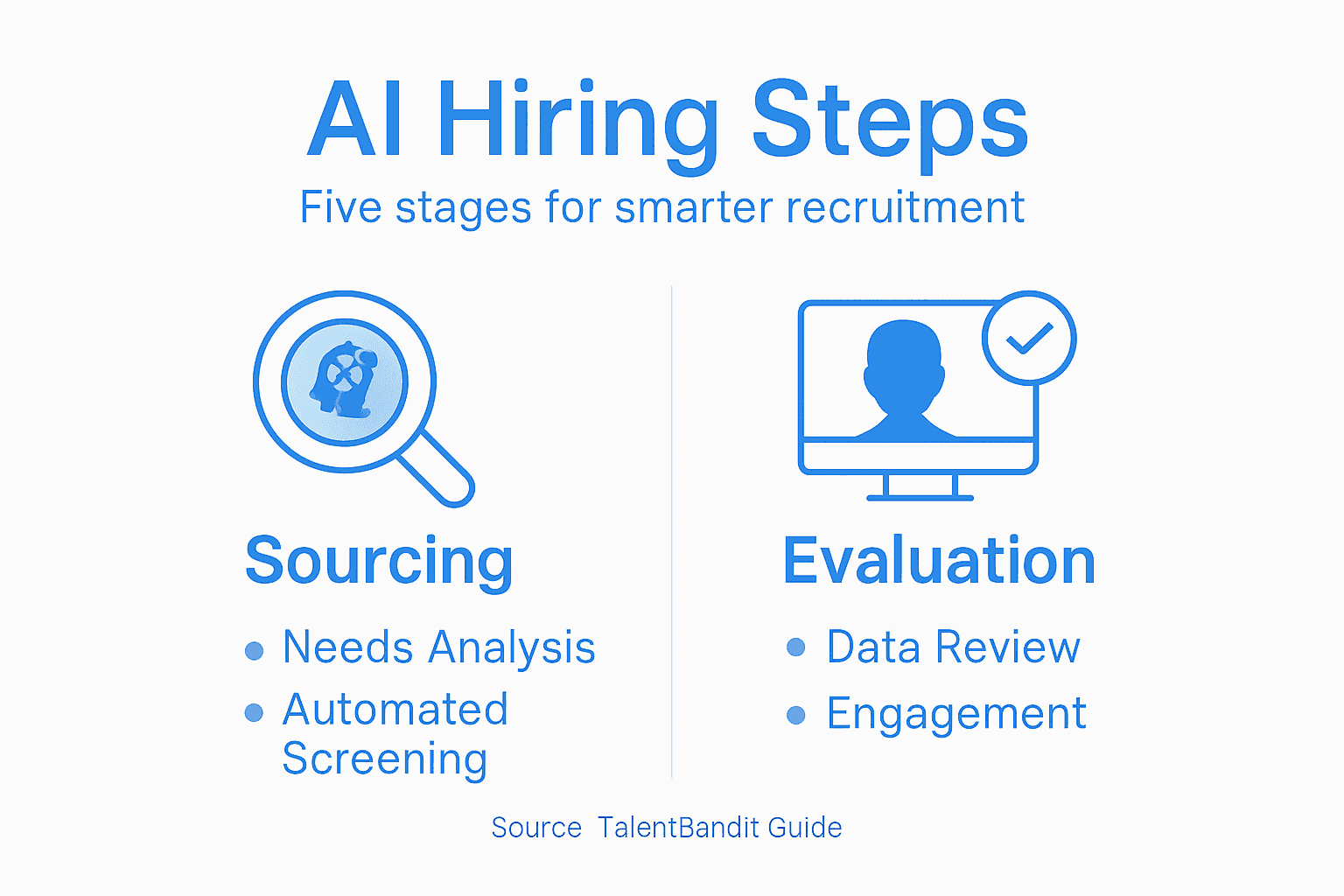
Compare candidates side-by-side using standardized metrics. Instead of one interviewer's impression versus another's, you have quantifiable data showing how candidates stack up across multiple dimensions. This transparency helps teams make confident decisions.
Track which evaluation criteria best predict long-term performance. After six months, compare your assessment scores against actual job performance. This feedback loop continuously improves your evaluation accuracy.
Measure what matters. Data removes the noise of personal preference and reveals genuine fit.
Pro tip: Set minimum thresholds for non-negotiable criteria, but allow flexibility on secondary factors. A developer with slightly lower communication scores but exceptional technical ability might outperform a more communicative candidate with weaker skills in your iGaming tech stack.
Step 4: Optimize Talent Engagement and Employer Visibility
You've evaluated candidates effectively. Now keep them engaged throughout the hiring process and strengthen your employer brand so top talent actively seeks you out. This step turns recruitment into a competitive advantage.
Begin by automating personalized candidate communication. AI-driven recruitment improves talent engagement through chatbots and automated, personalized communication, reducing candidate drop-offs and enhancing their experience. Instead of generic email templates, your system sends customized messages based on each candidate's profile, interests, and stage in the process.
Implement a multi-channel engagement strategy:
- Email updates with personalized interview feedback
- SMS reminders for upcoming interview schedules
- LinkedIn messages from hiring managers
- Chatbots answering frequently asked questions instantly
- Video messages from team members introducing company culture
Use predictive analytics to optimize your job ad placement and visibility. AI identifies which job boards, industry publications, and professional networks attract candidates who actually succeed in your organization. Rather than posting everywhere, you concentrate your budget where results happen.
Build employer visibility by showcasing your company culture and values. AI tools enhance employer visibility by supporting employee learning and retention, which strengthens your brand in the market. Share employee testimonials, career development opportunities, and behind-the-scenes content that resonates with iGaming professionals.
Create a candidate feedback loop that demonstrates transparency. After rejecting a candidate, send personalized feedback explaining why. This builds goodwill and keeps strong candidates interested in future opportunities.
Track engagement metrics throughout your process. Monitor response rates to outreach, time-to-acceptance, candidate satisfaction scores, and how many rejected candidates reapply later. These metrics reveal whether your engagement strategy is actually working.
Maintain ethical standards in all outreach. Be transparent about how you're using candidate data, respect privacy preferences, and ensure your automation feels human, not robotic. Trust is the foundation of employer visibility.
Engagement is two-way. Listen to candidates as much as you communicate with them.
Pro tip: Segment your candidate pool by profile type and customize your engagement journey accordingly. A passive candidate considering a move needs different messaging than an active job seeker eager to start immediately.
Step 5: Verify Hiring Outcomes and Refine Strategies
Hiring doesn't end when someone accepts the offer. This step measures whether your AI-driven process actually delivered quality hires and uses those insights to continuously improve your strategy. Without verification, you're flying blind.
Start by establishing clear success metrics for each hire. Define what excellent performance looks like in the first 90 days, six months, and one year. Track metrics like productivity, quality of work, team fit, retention, and contribution to company goals.
Compare your AI predictions against actual outcomes. Transparent AI recruitment systems enable verification of hiring outcomes by providing clear, explainable scoring and decision rationales. If your system predicted a candidate would excel but they underperformed, investigate why. Was the scoring criterion wrong? Did you misinterpret their assessment results?
Monitor these key verification points:
- Time-to-productivity compared to predictions
- Performance ratings versus AI fit scores
- Retention rates for candidates hired through different workflows
- Team satisfaction with new hires
- Hiring costs per successful placement
- Diversity outcomes of your hiring pipeline
Review hiring decisions with your team regularly. Discuss which candidates succeeded despite lower AI scores and which high-scoring candidates underperformed. This qualitative feedback reveals blind spots in your system.
Verification of hiring outcomes reveals that algorithmic systems may privilege narrow definitions of fairness, so continual assessment and adaptation are necessary. Your AI model might be optimizing for one type of success while missing important context. Hiring managers understand nuances the algorithm doesn't capture.
Create a feedback loop that improves your AI system. If certain evaluation criteria consistently mispredict performance, adjust their weighting. If specific sourcing channels deliver lower-quality candidates, reduce spending there. Use data to guide your refinements.
Document what you learn and communicate insights across your organization. When you discover that prior iGaming experience isn't as predictive as regulatory compliance knowledge, update your screening criteria accordingly. Share these learnings with your leadership team.
The best hiring system is never finished. It evolves based on real-world outcomes.
Pro tip: Set up a quarterly review cycle where you compare cohorts of hires. Track which screening criteria, interview questions, and evaluation weights predicted the best performers. Use this pattern to refine next quarter's hiring approach.
Below is a summary comparing traditional and AI-driven hiring in iGaming:
| Aspect | Traditional Approach | AI-Driven Approach |
|---|---|---|
| Time-to-hire | Weeks or months | Often reduced by 50% or more |
| Bias management | Relies on human judgment | Consistent, data-driven decisions |
| Candidate sourcing | Manual, limited reach | Automated, broad network search |
| Process scalability | Difficult to scale | Handles high volumes with ease |
| Quality verification | Gut feeling or periodic reviews | Ongoing, data-based feedback loops |
Unlock Smarter iGaming Hiring with AI-Powered Solutions
The article highlights the challenge of transforming traditional recruitment into a strategic, data-driven process that reduces bias, improves hiring speed, and ensures the right candidate fit in the competitive iGaming industry. Many hiring teams struggle with forecasting talent needs, automating candidate sourcing and screening, and verifying outcomes to refine strategies. These pain points demand a solution that delivers precise workforce intelligence, seamless engagement, and transparent evaluation.
TalentBandit answers these challenges head-on by providing an AI-powered hiring platform designed exclusively for iGaming operators across Malta and Europe. Our platform offers:
- AI-driven hiring insights tailored to predict your greatest talent needs
- Smart sourcing and screening workflows that find the best candidates faster
- Employer visibility tools that boost your brand among sought-after professionals
- Continuous performance verification to improve your hiring outcomes
Experience how transforming recruitment from reactive to strategic gives you a real competitive edge.
Ready to embrace an intelligent hiring future in iGaming That future starts today at TalentBandit. Discover how to improve hiring speed and accuracy with AI insights at TalentBandit and see how we streamline talent acquisition from workforce intelligence to candidate engagement. Visit TalentBandit to start turning your data into smarter hires now.
Frequently Asked Questions
How can AI tools help assess hiring needs in iGaming?
AI tools analyze historical hiring data to predict future talent demands accurately. Start by gathering turnover rates and time-to-fill metrics from your past hires to feed into the AI, which can forecast your staffing needs 3 to 6 months ahead.
What steps should I take to configure intelligent sourcing and screening workflows?
Set up automated systems that define your candidate sourcing strategy and screening parameters clearly. Specify target skills and experience levels and implement resume parsing to streamline candidate evaluation, potentially reducing screening time by over 50%.
How can I evaluate candidates objectivity with AI?
Use AI systems that analyze candidate interview responses using natural language processing. Collect comprehensive data from interviews and assessments to create a complete picture of each candidate's fit for the role, ensuring consistent evaluation across all applicants.
What strategies can I implement to enhance candidate engagement during the hiring process?
Automate personalized candidate communication using chatbots and individualized emails to keep candidates informed. Implement multi-channel engagement like SMS updates or LinkedIn messages to maintain interaction, which can decrease candidate drop-offs significantly.
How do I verify the effectiveness of my AI-driven hiring outcomes?
Establish key success metrics for each hire to track performance, retention, and overall contribution. Regularly compare your AI predictions against actual outcomes to identify areas of improvement in your hiring strategy and refine your approach based on real-world data.
What common mistakes should I avoid when using AI for iGaming recruitment?
Avoid relying solely on AI predictions without human judgment. It's crucial to continuously review and adjust your AI models based on feedback from your hiring teams to ensure that you are accounting for nuances that AI may miss.